
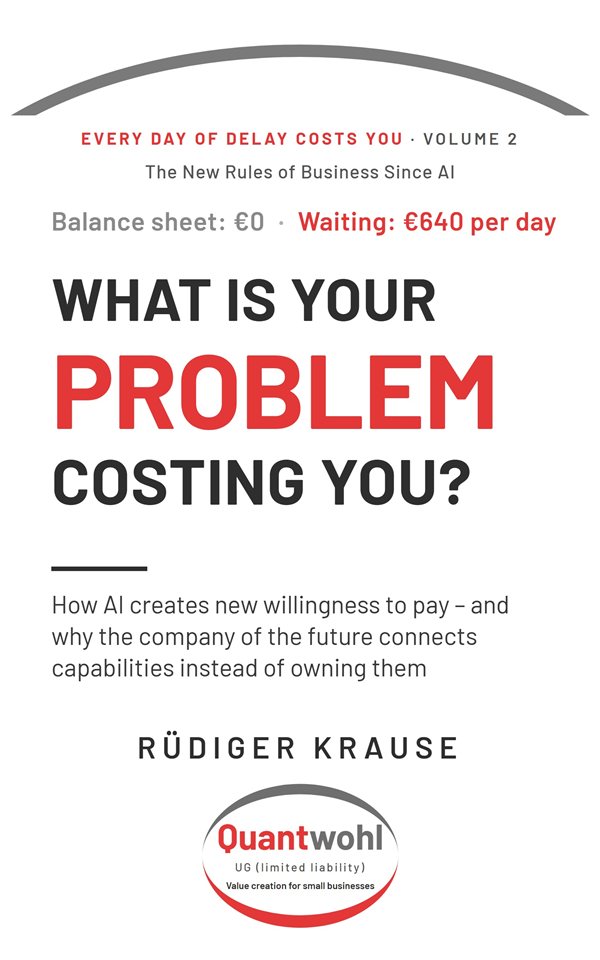
What is your
problem costing you?
How AI creates new willingness to pay – and why the company of the future connects capabilities instead of owning them.
by Rüdiger Krause · The New Rules of Business Since AI · e-book, paperback to follow
E-book as a download (EPUB, works with almost all e-readers and apps, including Kindle via “Send to Kindle”). Sold by our reseller Digistore24 (in the EU: Digistore24 GmbH, St.-Godehard-Straße 32, 31139 Hildesheim, Germany), who also sends your invoice. In Germany, the fixed book price of €12.99 applies. The paperback will follow.
60-day money-back guarantee from Digistore24: If the e-book does not convince you, you can return it through Digistore24 within 60 days of purchase and get your money back, under Digistore24's refund terms. If you are a consumer in the EU or the UK, you also have a statutory right of withdrawal; Digistore24 informs you about it in the order form. Returns and withdrawal
A problem only gets solved when the solution costs less than the problem.
That is a silent rule that has applied for as long as companies have existed. Everything else stays put. Not because it bothers no one, but because the solution doesn't pay off. The unanswered inquiry, the knowledge that is about to retire, the position nobody fills: every day costs money. It just doesn't appear on any balance sheet.
Artificial intelligence is lowering the cost of certain solutions right now. That tips the math for problems that have sat untouched for years. Whoever knows their costs is the first to see where new willingness to pay emerges, and why the company of the future connects capabilities instead of owning them.
What you will find inside
- The problem cost calculation: what every day without a solution costs you
- When a customer buys: problem costs versus price, switching and risk
- The thinking model "value creation in reverse" in nine stations, from the problem to repetition
- Why the skilled-labor shortage is a business model problem
- Own or access, trust as the new bottleneck, machines as buyers
- Ten case studies from a heating installer to an education provider, each with the calculation: What does a day of waiting cost?
- Ten tools and a 30-minute guide for your own business
Who the book is for
For owners, managing directors and managers of small and mid-sized companies, for the self-employed and for everyone who wants to know where AI is creating new business right now. Every technical term is explained, and there is a glossary. Every chapter ends with the question: what does a day of waiting cost?
How the book is structured
About 170 pages in seven parts, from the prologue "The Bill Nobody Opens" to the epilogue "If You Had to Start from Zero". One example accompanies you through the whole book: the supplier Kessler, where 15 inquiries go unanswered every month.
The new math
Which problems are becoming cheap enough to solve right now, and what this shifts in competition and work.
Access instead of ownership
Whether a company still has to do everything itself, why trust is the new bottleneck and whether machines will soon do the buying.
The new company
Founding from the problem, what this means for small and mid-sized companies, ten case studies and the toolbox.
All chapters
Part I · The New Math
1 Cheap Enough for the First Time · 2 The Costs That Appear on No Balance Sheet · 3 The Customer Doesn't Buy AI · 4 When a Problem Turns into Money · 5 The Best Business Idea Is Not an Idea
Part II · What Is Shifting
6 Where the Bottlenecks Move · 7 What Remains of a Person's Economic Value · 8 The Skilled-Labor Shortage Is a Business Model Problem
Part III · Own or Access
9 Why Companies Exist, Recalculated · 10 Who Still Has to Do Everything Themselves? · 11 The Value Creation Network
Part IV · Trust and Transaction
12 Found, Believed, Passed On: The New Bottleneck · 13 When Machines Do the Buying
Part V · The New Company
14 Value Creation in Reverse: Founding from the Problem · 15 What This Means for the Mittelstand
Part VI · Ten Case Studies
Skilled trades · Manufacturing · Logistics · Business services · Care · Online retail · Restaurants · Medical practice · Property management · Education provider
Part VII · Tools
The Toolbox · The 30-Minute Guide
Plus: epilogue, afterword, glossary and bibliography.
What does a day of waiting cost?
Every case study in the book ends with this question. Here you can see the answers for all ten industries. The companies are invented; the figures are sample calculations with disclosed assumptions, not forecasts. The full calculation, the solution and who keeps the advantage in the end are in the book.
| 1 | Skilled trades · heating installer, installers fully booked About €85 per working day in contribution margin, without a single additional installation hour |
|---|---|
| 2 | Manufacturing · supplier, inquiries go unanswered About €330 to €640 per working day in lost contribution margin |
| 3 | Logistics · trucking company with empty runs About €285 per working day in contribution margin from return loads |
| 4 | Business services · tax firm turning down clients About €180 in revenue per working day, twice as much in the second year |
| 5 | Care · home care service, writing instead of caring 12 hours of care time per day, about 1.5 full-time positions |
| 6 | Online retail · shop with many returns About €110 per working day in return costs and lost purchases |
| 7 | Restaurants · country inn, phone at peak times About €94 per opening day in missed reservations and waste |
| 8 | Medical practice · family practice, phone blocked About €90 in medical assistants' working time per practice day |
| 9 | Property management · overloaded, turning down properties About €215 in revenue per working day, twice as much in the second year |
| 10 | Education provider · new courses arrive too late About €127 per working day in contribution margin that comes later |
And for you? With the problem cost calculation in the book, you can work out in 30 minutes what your most expensive problem costs you every day.
Written in Germany, for the Mittelstand
This is the English edition of Was kostet dich dein Problem?. The book was written for small and mid-sized companies in Germany, the Mittelstand, and it stays there: the examples and case studies take place in Germany, the statistics come from German sources and all amounts are in euros. The mechanisms are not specific to Germany: a problem that costs more than its solution gets solved everywhere.
The series EVERY DAY OF DELAY COSTS YOU
The new rules of business since AI. Each volume works through a question that appears on no balance sheet.
What Is Your Problem Costing You?
Where does new willingness to pay emerge when solutions get cheaper?
About the author
Rüdiger Krause is a Certified Business Administrator (Geprüfter Betriebswirt, EQF level 7, equivalent to master's level) and the founder of Quantwohl in Germany. He spent his career in sales, in retail, wholesale and industry. His mission: value creation for small businesses.
Also by Rüdiger Krause: “Where Did the $4,950 Go?” (EVERY DAY OF DELAY COSTS YOU, Volume 1) and “Not Jobless. Founder.”, the 90-day plan to your own business idea.
Important: The book is an economic analysis and a basis for thinking. It is not legal, tax, financial or investment advice and does not guarantee success or income. Examples and calculations are assumptions. It was created and translated with the support of artificial intelligence and reviewed by humans, who are responsible for it. All people and companies in the case studies are fictional.